Design of a Lifetime

Kate Malooley, left, and Dr. Pat Polis, right, pose with Malooley's arranged matchbooks depicting Polis' life.
A graphic design class spent the past semester building intergenerational connections for an assignment that paired students with older adults. The final project was to create visual designs inspired by the stories and experiences they shared.
Sometimes, even the smallest objects can hold the greatest weight. A simple matchbox can spark a memory, symbolize personal history, or become a keepsake—preserving moments and meaning like a miniature time capsule.
Knoxville pastor and radio host Dr. Pat Polis experienced this firsthand when his life story was transformed into a series of custom-designed matchboxes, each reflecting a different chapter of his life: his two tours in Vietnam, the year he found his faith, and designs representing each of his three children and his 55-year marriage. One matchbox, titled Gayle Polis, features a recognizable logo inspired by the way Dr. Pat affectionately refers to his wife as “Betty Crocker.”
“I’m so pleased with her perspective and everything she created,” Dr. Pat said. “The unique creativity—and the fact that it’s a keepsake representing my life—I’ll treasure it forever.”
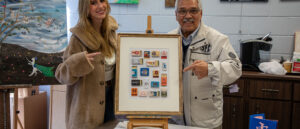
The matchbox designs were created by senior Kate Malooley, a marketing and graphic design major from Chicago, as part of Stories That Connect Us, a class project led by School of Design Professor Kimberly Mitchell.
“When I started developing concepts, I realized how much he had done and how many people had been part of his life,” Kate said. “Matchboxes felt like the right way to hold a lot of information. He had such an amazing story to tell.”
Modeled after a similar course at Kent State University, Mitchell created Stories That Connect Us to encourage meaningful intergenerational connection. Drawing on her research into how design can respond to the experience of aging, she structured the course to reframe how students think about growing older.
“My background in gerontology taught me how impactful intergenerational exchange can be,” Mitchell said. “This project is really about listening deeply and interpreting thoughtfully, using design to honor the stories people have trusted us with.”
Mitchell partnered with local organizations to recruit participants, including the Knoxville-Knox County Community Action Committee and the John T. O’Connor Senior Center.

“It’s important for younger generations to see older adults as people with rich, full lives—many of whom share their own interests,” said Dottie Lyvers, director of aging at CAC. “At the same time, this gives older adults a chance to share perspectives on aging that younger people might not encounter in the media or even within their own families.”
For Mary Sibbett, gerontologist and program manager at the O’Connor Senior Center, the project addressed a frustration she sees on both sides of the generational divide.
“Some older adults may think young people get on their computers and play games all day,” she said. “On the flip side, young people don’t understand that older adults still have a passion to live, learn, and stay active. This project created space for shared understanding.”
Participants completed interest forms detailing their hobbies, backgrounds, and interests, while students completed surveys of their own. Mitchell used this information to form sixteen partnerships.
Before meeting their partners, students received training from College of Social Work Associate Professor Lizzie Bowland, who led sessions on interviewing older adults with care and respect. Bowland coached students on building rapport, asking open-ended questions, and navigating sensitive topics. Students also participated in simulations using an aging suit from the College of Nursing to better understand physical changes associated with aging.
“Reframing aging is about moving away from stigma and toward connection,” Bowland said. “You start by seeing the person in front of you—without assumptions. Don’t talk louder unless it’s needed. Don’t use terms like ‘elderly’ or ‘sweetie.’ Be curious. Ask what they lived through and how those experiences shaped them.”
Once paired, students and their partners connected through phone calls, virtual meetings, and in-person visits. The group also came together for shared activities, from exercise classes to games. Mitchell saw these informal moments as a way to deepen relationships beyond structured interviews.
“Students weren’t just collecting information—they were building trust and understanding, which shaped their final work,” she said. “We wanted them to slow down and truly see the person in front of them, to form connections that went beyond the surface.”
Students recently showcased their individual design projects at a public exhibition at the O’Connor Senior Center, with many of their partners in attendance. Though the formats varied, every piece grew from conversations rooted in attention, understanding—and, perhaps most importantly—listening.
That principle is reflected in one of Kate’s matchboxes for Dr. Pat, inspired by his weekly date nights with his wife at Cancun, a Mexican restaurant they call their “happy place.”
“She’d tell me about her day, and I used to try to fix everything,” Dr. Pat said. “Then I learned—she didn’t want advice; she just wanted me to listen.”
Dr. Pat likened his relationship with Kate to a flower blossoming into a lasting friendship. The two plan to stay in touch, and she has been invited to his home for a meal—a chance she eagerly awaits to hear even more of his story.
“A lot of the process was just listening,” she said. “Talking about his perspective, his values, the people and stories that mattered to him, it was incredible. This project has been an amazing experience.”
-
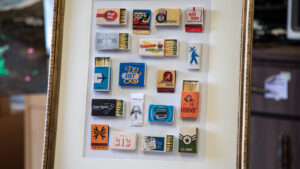
Malooley's matchbooks depicting Polis' life events.
-

Malooley's matchbooks depicting Polis' life events.
-

Malooley's matchbooks depicting Polis' life events.